



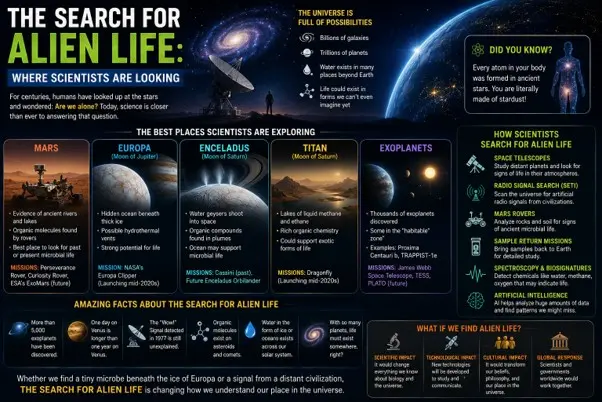
एलियन जीवन की खोज: वैज्ञानिक कहाँ तलाश कर रहे हैं?
क्या हम ब्रह्मांड में सचमुच अकेले हैं?
क्या इस विशाल ब्रह्मांड में केवल पृथ्वी पर ही जीवन मौजूद है, या कहीं कोई और सभ्यता भी हमारी तरह आसमान की ओर देखकर यही सवाल पूछ रही है?
हजारों वर्षों से इंसान इस रहस्य का जवाब खोजने की कोशिश कर रहा है। आज यह केवल कल्पना या विज्ञान-कथा का विषय नहीं रह गया है। आधुनिक विज्ञान की मदद से वैज्ञानिक मंगल ग्रह पर रोवर चला रहे हैं, बर्फीले चंद्रमाओं की जांच कर रहे हैं और हजारों दूरस्थ ग्रहों का अध्ययन कर रहे हैं, ताकि यह पता लगाया जा सके कि क्या पृथ्वी के अलावा कहीं और भी जीवन मौजूद है।
वैज्ञानिकों को क्यों लगता है कि एलियन जीवन हो सकता है?
ब्रह्मांड इतना विशाल है कि इसकी कल्पना करना भी मुश्किल है।
- हमारी आकाशगंगा मिल्की वे में लगभग 100 से 400 अरब तारे हैं।
- वैज्ञानिकों के अनुमान के अनुसार पूरे ब्रह्मांड में लगभग 2 ट्रिलियन (दो लाख करोड़) आकाशगंगाएँ मौजूद हैं।
- अब तक वैज्ञानिक 6,000 से अधिक एक्सोप्लैनेट (दूसरे तारों की परिक्रमा करने वाले ग्रह) खोज चुके हैं, जबकि हजारों ग्रहों की पुष्टि अभी बाकी है।
अगर इन ग्रहों में से केवल एक छोटा-सा हिस्सा भी जीवन के अनुकूल हो, तो एलियन जीवन की संभावना काफी बढ़ जाती है।
पृथ्वी भी देती है संकेत
पृथ्वी पर ऐसे सूक्ष्म जीव पाए गए हैं जो—
- उबलते गर्म पानी के झरनों में जीवित रहते हैं।
- अंटार्कटिका की जमी हुई झीलों में रहते हैं।
- समुद्र की गहराई में बिना सूर्य के प्रकाश के भी जीवित रहते हैं।
इससे वैज्ञानिकों का मानना है कि दूसरे ग्रहों पर जीवन इंसानों जैसा होना जरूरी नहीं है। वह सूक्ष्मजीवों के रूप में या बिल्कुल अलग जैविक संरचना वाला भी हो सकता है।
वैज्ञानिक किन जगहों पर एलियन जीवन खोज रहे हैं?
1. मंगल ग्रह (Mars)
मंगल ग्रह कभी पानी से भरपूर था।
वैज्ञानिकों को यहाँ मिले हैं—
- सूखी नदी की घाटियाँ
- प्राचीन झीलों के निशान
- ऐसे खनिज जो केवल पानी में बनते हैं
- कार्बन आधारित ऑर्गेनिक अणु
NASA के Curiosity और Perseverance रोवर लगातार मंगल की सतह का अध्ययन कर रहे हैं।
हालाँकि अभी तक जीवन का कोई प्रमाण नहीं मिला है, लेकिन मंगल आज भी सौर मंडल में जीवन खोजने की सबसे महत्वपूर्ण जगहों में से एक माना जाता है।
2. यूरोपा (Europa) – बृहस्पति का चंद्रमा
दूर से देखने पर यूरोपा एक फटे हुए अंडे जैसा दिखाई देता है।
इसके नीचे छिपा है—
- एक विशाल खारे पानी का महासागर
- जिसमें पृथ्वी के सभी महासागरों से भी अधिक पानी होने की संभावना है।
वैज्ञानिकों का मानना है कि समुद्र की गहराई में हाइड्रोथर्मल वेंट हो सकते हैं, जहाँ पृथ्वी की तरह सूक्ष्म जीवन विकसित हो सकता है।
यूरोपा क्लिपर मिशन
NASA का Europa Clipper, जिसे अक्टूबर 2024 में लॉन्च किया गया, 2030 में यूरोपा पहुँचेगा और वहाँ जीवन के अनुकूल परिस्थितियों की जांच करेगा।
3. एन्सेलाडस (Enceladus) – शनि का चंद्रमा
एन्सेलाडस अंतरिक्ष में पानी और बर्फ के विशाल फव्वारे छोड़ता है।
NASA के Cassini मिशन ने इन फव्वारों में पाया—
- पानी
- ऑर्गेनिक यौगिक
- हाइड्रोजन गैस
जीवन के लिए आवश्यक तीन मुख्य तत्व—
- तरल पानी
- ऊर्जा का स्रोत
- कार्बनिक रसायन
तीनों यहाँ मौजूद हैं।
इसी कारण एन्सेलाडस को जीवन खोजने के लिए सबसे आशाजनक स्थानों में गिना जाता है।
4. टाइटन (Titan) – शनि का सबसे बड़ा चंद्रमा
टाइटन वास्तव में एक बेहद अलग दुनिया है।
यहाँ—
- झीलें और नदियाँ हैं,
- लेकिन इनमें पानी नहीं बल्कि तरल मीथेन और एथेन भरे हुए हैं।
इसका घना नारंगी वातावरण जटिल कार्बनिक रसायनों से भरपूर है।
वैज्ञानिकों का मानना है कि यदि यहाँ जीवन होगा, तो वह पृथ्वी के जीवन से बिल्कुल अलग प्रकार का हो सकता है।
5. एक्सोप्लैनेट (Exoplanets)
सौर मंडल से बाहर मौजूद ग्रहों पर भी जीवन की खोज जारी है।
वैज्ञानिक विशेष रूप से उन ग्रहों पर ध्यान देते हैं जो अपने तारे के Habitable Zone (जीवन योग्य क्षेत्र) में स्थित हैं, जहाँ तरल पानी मौजूद हो सकता है।
प्रमुख एक्सोप्लैनेट
- Proxima Centauri b – पृथ्वी का सबसे निकट ज्ञात एक्सोप्लैनेट
- TRAPPIST-1 सिस्टम – सात चट्टानी ग्रहों वाला तारकीय सिस्टम, जिनमें से कई जीवन के अनुकूल तापमान वाले क्षेत्र में हैं।
वैज्ञानिक एलियन जीवन की खोज कैसे करते हैं?
एलियन जीवन की खोज के लिए वैज्ञानिक कई आधुनिक तकनीकों और उपकरणों का उपयोग करते हैं। यह केवल एक दूरबीन या एक अंतरिक्ष यान का काम नहीं है, बल्कि विभिन्न वैज्ञानिक तरीकों का संयुक्त प्रयास है।
सबसे पहले, स्पेस टेलीस्कोप, जैसे जेम्स वेब स्पेस टेलीस्कोप (James Webb Space Telescope - JWST), दूर स्थित एक्सोप्लैनेट्स के वायुमंडल का अध्ययन करते हैं। वैज्ञानिक इन ग्रहों के वातावरण में ऑक्सीजन, मीथेन या अन्य ऐसी गैसों की तलाश करते हैं जिन्हें बायोसिग्नेचर (Biosignature) कहा जाता है। ये ऐसे रासायनिक संकेत हैं जो किसी ग्रह पर जैविक गतिविधि या जीवन की संभावना का संकेत दे सकते हैं।
इसके अलावा, SETI (Search for Extraterrestrial Intelligence) परियोजना अंतरिक्ष से आने वाले रेडियो संकेतों की लगातार निगरानी करती है। इसका उद्देश्य ऐसे कृत्रिम सिग्नलों की पहचान करना है जो किसी बुद्धिमान एलियन सभ्यता द्वारा भेजे गए हो सकते हैं।
मंगल ग्रह पर भेजे गए रोवर चट्टानों और मिट्टी में ड्रिलिंग करके कार्बनिक यौगिकों (Organic Compounds) की खोज करते हैं। ये यौगिक जीवन के निर्माण में महत्वपूर्ण भूमिका निभाते हैं और अतीत में जीवन की मौजूदगी के संकेत दे सकते हैं।
वैज्ञानिक सैंपल रिटर्न मिशन (Sample Return Missions) पर भी काम कर रहे हैं, जिनका उद्देश्य अन्य ग्रहों, चंद्रमाओं या क्षुद्रग्रहों से वास्तविक नमूने पृथ्वी पर लाकर अत्याधुनिक प्रयोगशालाओं में उनका विस्तृत विश्लेषण करना है।
एक और महत्वपूर्ण तकनीक स्पेक्ट्रोस्कोपी (Spectroscopy) है। इसकी मदद से वैज्ञानिक किसी दूरस्थ ग्रह पर गए बिना ही वहाँ से आने वाले प्रकाश के रासायनिक "फिंगरप्रिंट" को पढ़ सकते हैं और यह पता लगा सकते हैं कि उसके वातावरण में कौन-कौन से तत्व और गैसें मौजूद हैं।
आज के समय में कृत्रिम बुद्धिमत्ता (Artificial Intelligence - AI) भी इस खोज का महत्वपूर्ण हिस्सा बन चुकी है। AI अरबों डेटा पॉइंट्स का विश्लेषण करके ऐसे सूक्ष्म पैटर्न और संकेत पहचान सकती है जिन्हें इंसान आसानी से नहीं देख पाते। इससे एलियन जीवन की खोज पहले की तुलना में कहीं अधिक तेज़ और प्रभावी होती जा रही है।
क्या एलियन जीवन केवल सूक्ष्मजीव हो सकता है?
अधिकांश वैज्ञानिक मानते हैं कि यदि हमें सबसे पहले कहीं जीवन मिलेगा, तो वह संभवतः बैक्टीरिया जैसे सूक्ष्मजीव होंगे, न कि कोई उन्नत सभ्यता।
सूक्ष्म जीवन विकसित होना आसान होता है और वह कठोर परिस्थितियों में भी लंबे समय तक जीवित रह सकता है।
फर्मी विरोधाभास (Fermi Paradox)
यदि ब्रह्मांड इतना विशाल और पुराना है, तो अब तक हमें किसी बुद्धिमान सभ्यता का पता क्यों नहीं चला?
संभावित उत्तर—
- बुद्धिमान जीवन बहुत दुर्लभ हो सकता है।
- सभ्यताएँ लंबे समय तक जीवित नहीं रहतीं।
- वे इतनी दूर हैं कि उनके संकेत हम तक नहीं पहुँचते।
- या उनका संचार तरीका हमारी तकनीक से बिल्कुल अलग है।
सबसे बड़ी चुनौतियाँ
- अंतरिक्ष की विशाल दूरी
- कमजोर होते रेडियो संकेत
- तकनीकी सीमाएँ
- हमें यह भी नहीं पता कि पृथ्वी से अलग जीवन कैसा दिखेगा
- बाहरी ग्रहों तक पहुँचने में कई दशक लग सकते हैं
एलियन खोज से जुड़े रोचक तथ्य
- अब तक 6,000 से अधिक एक्सोप्लैनेट खोजे जा चुके हैं।
- शुक्र ग्रह पर एक दिन, उसके एक वर्ष से भी लंबा होता है।
- 1977 में मिला रहस्यमयी "Wow! Signal" आज तक पूरी तरह समझाया नहीं जा सका।
- सौर मंडल के कई हिस्सों में पानी के प्रमाण मिले हैं।
- धूमकेतुओं और क्षुद्रग्रहों पर भी ऑर्गेनिक अणु पाए गए हैं।
- एन्सेलाडस के पानी के फव्वारे 100 मील से भी अधिक ऊँचाई तक पहुँचते हैं।
- TRAPPIST-1 सिस्टम में एक छोटे तारे के चारों ओर सात ग्रह मौजूद हैं।
क्या आप जानते हैं?
आपके शरीर में मौजूद कार्बन, ऑक्सीजन, कैल्शियम और आयरन जैसे सभी तत्व अरबों साल पहले विशाल तारों के अंदर बने थे।
यानी एक अर्थ में हम सभी सचमुच तारों की धूल (Stardust) से बने हैं।
अगर एलियन जीवन मिल जाए तो क्या होगा?
यदि वैज्ञानिकों को किसी दूसरे ग्रह पर केवल सूक्ष्मजीव भी मिल जाते हैं, तो यह मानव इतिहास की सबसे बड़ी वैज्ञानिक खोजों में से एक होगी।
इससे—
- जीवविज्ञान की हमारी समझ बदल जाएगी,
- नई अंतरिक्ष तकनीकों का विकास होगा,
- और मानवता को ब्रह्मांड में अपनी जगह पर फिर से विचार करना पड़ेगा।
तुलना तालिका
स्थान
जीवन की संभावना क्यों?
मिले प्रमाण
वर्तमान/भविष्य मिशन
मंगल ग्रह
कभी तरल पानी मौजूद था
सूखी नदियाँ, झीलें, ऑर्गेनिक अणु
Perseverance, Curiosity, भविष्य के Sample Return मिशन
यूरोपा
बर्फ के नीचे विशाल महासागर
फटी हुई बर्फ, खारे पानी के संकेत
Europa Clipper (2030)
एन्सेलाडस
पानी, ऊर्जा और ऑर्गेनिक रसायन
पानी के फव्वारे, हाइड्रोजन, ऑर्गेनिक यौगिक
भविष्य के फ्लाईबाय और सैंपल मिशन प्रस्तावित
टाइटन
अनोखी रासायनिक संरचना
मीथेन की झीलें और घना वातावरण
Dragonfly मिशन (2030 का दशक)
एक्सोप्लैनेट
जीवन योग्य क्षेत्र में स्थित
वातावरण का अध्ययन जारी
James Webb Telescope और भविष्य की दूरबीनें
निष्कर्ष
मंगल की सूखी नदियों से लेकर यूरोपा और एन्सेलाडस के छिपे महासागरों तक, और हमारी आकाशगंगा में फैले हजारों एक्सोप्लैनेट तक—एलियन जीवन की खोज मानव इतिहास के सबसे रोमांचक वैज्ञानिक अभियानों में से एक है।
हो सकता है कि भविष्य में हमें किसी बर्फीले महासागर में एक सूक्ष्म जीव मिल जाए, या किसी दूरस्थ सभ्यता का संकेत प्राप्त हो जाए। लेकिन एक बात निश्चित है—यह खोज लगातार हमें यह समझने में मदद कर रही है कि इस असीम ब्रह्मांड में हमारी वास्तविक जगह क्या है।
त्वरित तथ्य (Quick Facts)
- 6,000 से अधिक एक्सोप्लैनेट की पुष्टि हो चुकी है।
- यूरोपा के महासागर में पृथ्वी के सभी महासागरों से अधिक पानी हो सकता है।
- एन्सेलाडस अंतरिक्ष में पानी के विशाल फव्वारे छोड़ता है।
- टाइटन पर पानी नहीं बल्कि तरल मीथेन की झीलें हैं।
- Europa Clipper मिशन 2030 में बृहस्पति प्रणाली तक पहुँचेगा।
- फर्मी विरोधाभास आज भी विज्ञान के सबसे बड़े अनसुलझे सवालों में से एक है।
अक्सर पूछे जाने वाले प्रश्न (FAQ)
प्रश्न 1: क्या अब तक एलियन जीवन मिल चुका है?
उत्तर: नहीं। अभी तक किसी भी प्रकार के एलियन जीवन की आधिकारिक पुष्टि नहीं हुई है। वैज्ञानिकों को केवल जीवन के अनुकूल परिस्थितियाँ और रासायनिक संकेत मिले हैं।
प्रश्न 2: वैज्ञानिक पानी पर इतना ज़ोर क्यों देते हैं?
उत्तर: क्योंकि पृथ्वी पर ज्ञात हर प्रकार का जीवन तरल पानी पर निर्भर करता है, इसलिए वैज्ञानिक सबसे पहले पानी की तलाश करते हैं।
प्रश्न 3: बायोसिग्नेचर क्या होता है?
उत्तर: किसी ग्रह के वातावरण में मौजूद ऐसे रासायनिक या भौतिक संकेत जो जैविक गतिविधि की संभावना दर्शाते हैं, उन्हें बायोसिग्नेचर कहा जाता है।
प्रश्न 4: क्या एलियन जीवन इंसानों के लिए खतरनाक हो सकता है?
उत्तर: अधिकांश वैज्ञानिकों का मानना है कि यदि निकट भविष्य में जीवन मिलेगा, तो वह सूक्ष्मजीवों के रूप में होगा और उससे कोई तत्काल खतरा नहीं होगा। फिर भी सभी अंतरिक्ष मिशन सख्त सुरक्षा नियमों का पालन करते हैं।
प्रश्न 5: अभी तक बुद्धिमान एलियन क्यों नहीं मिले?
उत्तर: यही फर्मी विरोधाभास का मुख्य प्रश्न है। संभव है कि बुद्धिमान जीवन बहुत दुर्लभ हो, बहुत दूर हो, या हमारी वर्तमान तकनीक से उसका पता लगाना संभव न हो।
Are we really alone in the universe, or is someone else looking back at us?
Humans have asked this question since we first looked up at the night sky and wondered what those tiny lights actually were. Today, the search for alien life isn't just a question for poets and philosophers. It's an active, ongoing scientific mission, with rovers crawling across Mars, spacecraft orbiting icy moons, and telescopes scanning thousands of distant worlds for the faintest hint that we're not the only ones here.
Why Do Scientists Believe Alien Life Could Exist?
The universe is almost impossibly big. Our galaxy alone, the Milky Way, holds somewhere between 100 and 400 billion stars. And the Milky Way is just one of roughly two trillion galaxies that astronomers estimate exist.
Within our own galaxy, scientists have confirmed more than 6,000 exoplanets, which are planets orbiting stars other than our sun. Thousands more candidates are waiting on confirmation. If even a tiny fraction of those planets have the right conditions, the numbers start to feel less like science fiction and more like simple math.
Life on Earth has also shown up in strange, unexpected places. Microbes survive in boiling hot springs, frozen Antarctic lakes, and deep-sea vents with no sunlight at all. That toughness suggests life elsewhere might not look like us at all. It might be microbial, chemical, or built on a completely different biological blueprint.
The Best Places Scientists Are Searching
-
Mars
Mars used to be wet. Orbiters and rovers have found dried-up riverbeds, ancient lake basins, and minerals that only form in water. NASA's Curiosity and Perseverance rovers have also detected organic molecules, the carbon-based building blocks associated with life, in Martian rock samples.
None of this proves life existed there. But Mars checks enough boxes, past water, the right chemistry, and a thin atmosphere, that it remains one of the top candidates in our solar system.
-
Europa, the moon of Jupiter
Europa looks like a cracked egg from space, and that's because of what's underneath. Beneath its icy shell sits a massive saltwater ocean, possibly containing more water than all of Earth's oceans combined.
Scientists suspect Europa may have hydrothermal vents on its ocean floor, similar to the ones that support thriving ecosystems deep in Earth's oceans. NASA's Europa Clipper, launched in October 2024, is currently on its way there, with arrival expected in 2030 to study whether conditions below that ice could support life.
-
Enceladus, the moon of Saturn
Enceladus puts on a show. Geysers of water vapor and ice shoot out from cracks near its south pole, spraying material straight into space. NASA's Cassini spacecraft flew through these plumes and detected organic compounds, along with hydrogen, a possible energy source for microbial life.
That combination of liquid water, organic chemistry, and an energy source makes Enceladus one of the most promising spots for life as we understand it.
-
Titan, the moon of Saturn
Titan is genuinely alien. It has lakes and rivers, but they're filled with liquid methane and ethane instead of water. Its thick orange atmosphere is rich in complex organic chemistry.
Life on Titan, if it exists, probably wouldn't resemble anything on Earth. Some scientists think Titan could host a completely different kind of biology built on different chemical rules entirely.
-
Exoplanets
Beyond our solar system, astronomers focus on the "habitable zone," the range around a star where temperatures could allow liquid water to exist. Proxima Centauri b, the closest known exoplanet to Earth, sits in its star's habitable zone. The TRAPPIST-1 system has seven rocky planets, several of which orbit in a temperature range that could support liquid water.
These planets are too far away to visit, but they're close enough for telescopes to study their atmospheres for clues.
How Scientists Search for Alien Life
The search relies on a mix of tools. Space telescopes, like the James Webb Space Telescope, study the atmospheres of distant exoplanets, looking for biosignatures, chemical signs like oxygen or methane that might indicate biological activity.
SETI, the Search for Extraterrestrial Intelligence, scans radio frequencies for signals that might come from an intelligent civilization. Rovers on Mars drill into rock and soil, searching for organic chemistry.
Sample return missions aim to bring actual material back to Earth for detailed lab analysis. Spectroscopy lets scientists read the chemical fingerprint of light from distant planets without ever visiting them.
And increasingly, artificial intelligence helps sift through enormous datasets, spotting patterns humans might miss.
Could Alien Life Be Microbial Instead of Intelligent?
Most scientists expect that if we find life elsewhere, it'll be simple, something like bacteria, not a civilization. Microbial life is the easiest to evolve and the toughest to wipe out.
This connects to the Fermi Paradox, a famous puzzle that asks: if the universe is so vast and old, where is everybody? Maybe intelligent life is rare. Maybe it doesn't survive long. Or maybe it's out there, just too far away or too different for us to notice yet.
The Biggest Challenges
Space is enormous, and even light takes years or centuries to cross it. Signals weaken over those distances, technology has real limits, and we genuinely don't know what non-Earth life might look like or how to detect it. On top of that, missions to outer planets and moons can take a decade or more to even arrive.
Amazing Facts About the Search for Alien Life
More than 6,000 exoplanets have been confirmed so far, with thousands more candidates awaiting confirmation. A day on Venus, measured by its rotation, is longer than its year around the sun. The mysterious "Wow! Signal," picked up in 1977, has never been fully explained. Water has been found throughout the solar system, from polar ice on Mars to hidden oceans on icy moons.
Organic molecules have turned up on asteroids and comets, not just planets. Saturn's moon Enceladus shoots water geysers more than 100 miles into space. The TRAPPIST-1 system packs seven planets around a single small star.
Did You Know?
Every atom in your body, the carbon, oxygen, calcium, and iron, was forged inside ancient stars that lived and died long before our sun existed. In a very real sense, you are made of stardust.
What Happens If We Find Alien Life?
Even discovering simple microbes elsewhere would be one of the biggest scientific moments in human history. It would reshape biology, fuel new technology aimed at detection and exploration, and force a rethink of humanity's place in the cosmos. Governments and scientific bodies would likely move carefully, verifying findings repeatedly before any public announcement, given how enormous the implications would be.
Comparison Table
|
Location |
Why It's Promising |
Evidence Found |
Current/Future Missions |
|
Mars |
Once had liquid water; thin atmosphere; accessible by rover |
Ancient riverbeds, lake basins, organic molecules in rock samples |
Perseverance and Curiosity rovers; future sample return missions |
|
Europa |
Subsurface ocean with possible hydrothermal vents |
Cracked ice surface, strong evidence of a salty ocean beneath |
NASA's Europa Clipper (en route, arrives 2030) |
|
Enceladus |
Liquid water, organic chemistry, and an energy source all present |
Water/ice geysers sampled by Cassini, containing organics and hydrogen |
Proposed future flyby and sample missions under study |
|
Titan |
Unique chemistry that could support non-water-based life |
Lakes and rivers of liquid methane and ethane; thick organic-rich atmosphere |
Dragonfly rotorcraft mission planned for the 2030s |
|
Exoplanets (e.g., TRAPPIST-1, Proxima Centauri b) |
Located in their star's habitable zone |
Detected via transit and radial velocity methods; atmospheres under study |
James Webb Space Telescope atmospheric studies; future telescopes |
Conclusion
From the dry riverbeds of Mars to the icy oceans of Europa and Enceladus, to thousands of exoplanets scattered across the galaxy, the search for alien life is one of humanity's most ambitious undertakings. Whether we discover a tiny microbe beneath the ice of Europa or receive a signal from a distant civilization, one thing is certain: the search itself is changing how we understand our place in the universe.
Quick Facts Box
-
Over 6,000 exoplanets confirmed, with thousands more candidates awaiting verification
-
Europa's hidden ocean may hold more water than all of Earth's oceans combined
-
Enceladus shoots water geysers into space, detected and sampled by NASA's Cassini spacecraft
-
Titan has lakes of liquid methane instead of water
-
NASA's Europa Clipper, launched October 2024, arrives at Jupiter in 2030
-
The Fermi Paradox asks why, in such a vast universe, we haven't found intelligent life yet
FAQ Section
Q: Has alien life actually been found?
No. No confirmed alien life, microbial or intelligent, has been discovered. Scientists have found promising conditions and chemical building blocks, but not life itself.
Q: Why do scientists focus so much on water?
Every known form of life on Earth requires liquid water to survive. It's the one ingredient scientists are confident is essential, so they look for it first.
Q: What is a biosignature?
A biosignature is any chemical or physical sign, like a particular gas in a planet's atmosphere, that could indicate biological activity is happening there.
Q: Could alien life be dangerous?
Most scientists expect that if life exists nearby, it's likely microbial and poses no threat to humans. Missions like sample returns follow strict contamination protocols in both directions, just to be safe.
Q: Why haven't we found intelligent alien life yet?
This is the heart of the Fermi Paradox. Possible explanations include that intelligent life is extremely rare, doesn't last very long, or exists but is too far away or too different for us to detect with current technology.


Be the first to comment on this post.