



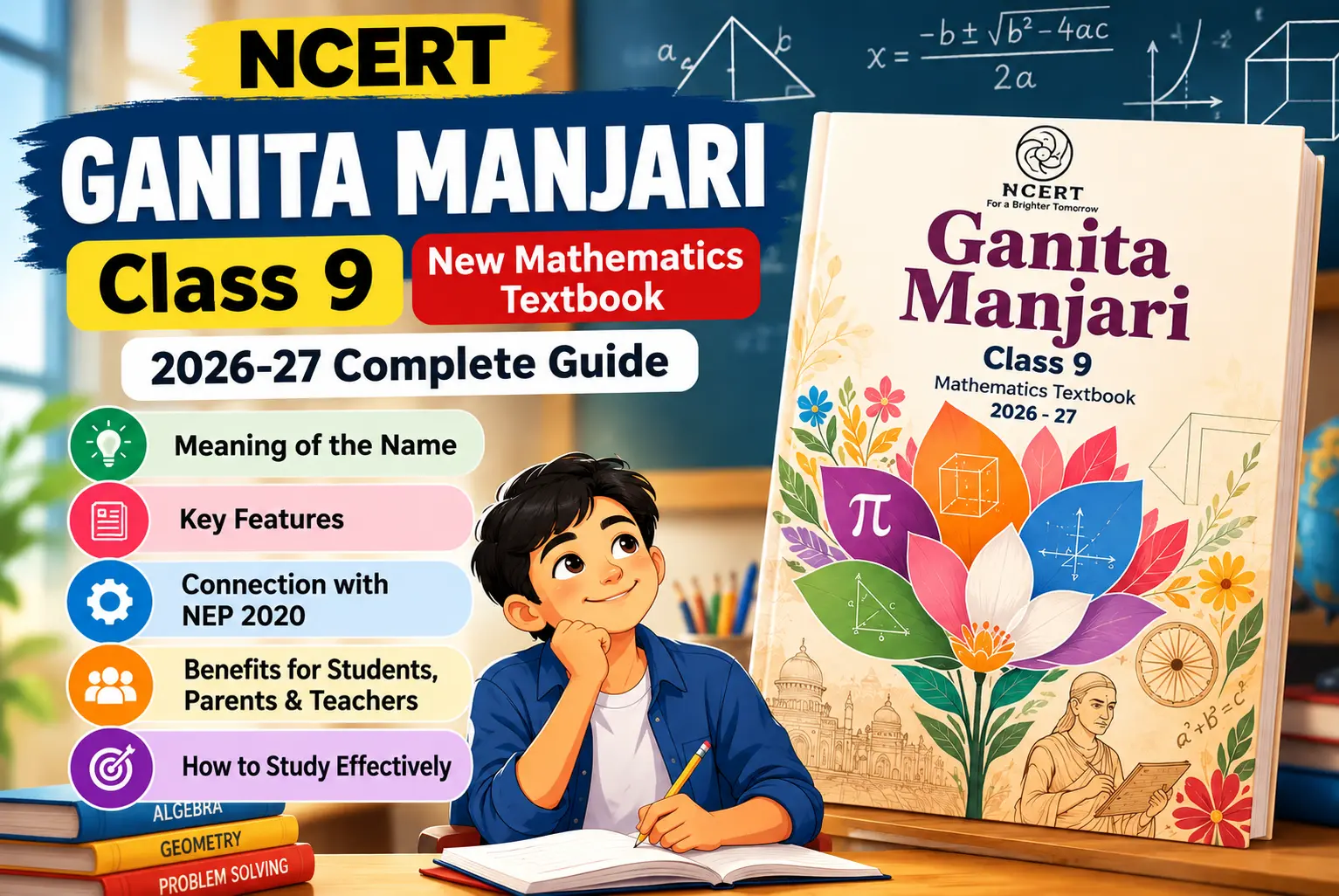
Ganita Manjari Class 9: New NCERT Maths Textbook 2026-27
Ganita Manjari Class 9: Everything You Need to Know About the New NCERT Maths Textbook 2026-27
Mathematics is often seen as a subject of formulas, calculations, and problem-solving. But what if students could learn mathematics by exploring ideas, asking questions, understanding patterns, and connecting concepts with everyday life?
This is the approach behind Ganita Manjari, the new NCERT Class 9 Mathematics textbook introduced for the 2026–27 academic session.
The new textbook represents a shift from simply memorizing mathematical procedures toward developing logical thinking, conceptual understanding, problem-solving skills, and curiosity about mathematics.
For Class 9 students, parents, and teachers, Ganita Manjari is an important change in the way mathematics is presented and learned.
What Is Ganita Manjari?
Ganita Manjari is the new Class 9 Mathematics textbook introduced by NCERT for the 2026–27 school year.
The book replaces the older Class 9 Mathematics textbook and follows the broader educational direction outlined under India's National Education Policy (NEP) 2020.
Instead of presenting mathematics only as a collection of formulas and standard procedures, the book encourages students to understand why a mathematical concept works and where it can be used.
Students are introduced to mathematical ideas through questions, situations, stories, patterns, and problems that encourage them to think before moving toward formal methods.
What Does the Name Ganita Manjari Mean?
The name Ganita Manjari has an interesting meaning.
Ganita is an ancient Indian term associated with mathematics, while Manjari refers to a bouquet or cluster of flowers.
Together, the name can be understood as a bouquet of mathematics.
The idea reflects the diversity and beauty of mathematics. Just as a bouquet contains different flowers, mathematics contains many interconnected ideas such as numbers, geometry, patterns, algebra, measurement, logic, and problem-solving.
This makes the name particularly appropriate for a textbook that aims to present mathematics as a subject full of exploration and discovery.
Why Was a New Class 9 Maths Book Introduced?
The introduction of Ganita Manjari is part of the broader transformation taking place in school education in India.
Traditional mathematics education can sometimes encourage students to remember a formula or follow a fixed procedure without fully understanding the reasoning behind it.
The new approach places greater emphasis on:
-
Conceptual understanding
-
Logical reasoning
-
Problem-solving
-
Mathematical thinking
-
Real-life applications
-
Exploration and observation
-
Connecting different mathematical concepts
The objective is not simply to help students obtain the correct answer, but also to help them understand how they reached that answer and why the method works.
Key Features of Ganita Manjari Class 9
1. Learning Mathematics Through Questions
One of the notable features of Ganita Manjari is its question-oriented approach.
Instead of immediately giving students a formula or method, lessons can begin with a situation, question, or problem that encourages students to think.
This approach can help students become active participants in the learning process rather than simply following instructions.
2. Focus on Logical Thinking
Mathematics requires more than calculation.
Students need to identify patterns, make connections, analyze information, test ideas, and develop logical arguments.
Ganita Manjari places greater emphasis on these skills so that students can develop a deeper understanding of mathematical concepts.
3. Connection With Real Life
Mathematics is used everywhere—from shopping and budgeting to construction, technology, measurement, data analysis, and science.
The new textbook aims to connect mathematical concepts with situations that students can recognize in their everyday lives.
This can make abstract mathematical ideas easier to understand and demonstrate why mathematics is useful beyond examinations.
4. Story-Based Learning
Another interesting aspect of the book is the use of stories and situations to introduce mathematical ideas.
Rather than presenting every concept as a definition followed by exercises, students may first encounter a problem or situation that leads them toward the underlying mathematical concept.
This approach can make lessons more engaging while encouraging students to ask questions and explore possible solutions.
5. Indian Mathematical Heritage
Ganita Manjari also brings attention to India's mathematical heritage.
Indian mathematicians and mathematical ideas have played an important role in the development of mathematics over centuries.
Introducing students to this history can help them understand that mathematics is not merely a modern classroom subject but a field that has developed through contributions from different civilizations and thinkers.
Ganita Manjari and NEP 2020
The new textbook follows the educational direction associated with National Education Policy 2020, which emphasizes understanding, critical thinking, competency-based learning, and reducing excessive dependence on rote memorization.
For mathematics, this means encouraging students to develop the ability to:
-
Understand concepts
-
Apply knowledge in different situations
-
Reason mathematically
-
Solve unfamiliar problems
-
Explain their thinking
-
Connect classroom learning with real-world situations
Ganita Manjari reflects this broader change in the way school mathematics is intended to be taught.
How Is Ganita Manjari Different From the Older Class 9 Maths Book?
The biggest difference is the learning approach.
The older style of mathematics education often placed considerable emphasis on learning formulas, methods, examples, and exercises.
Ganita Manjari aims to put more emphasis on the thinking process behind mathematics.
| Traditional Approach | Ganita Manjari Approach |
|---|---|
| Memorizing formulas | Understanding concepts |
| Following fixed procedures | Exploring different approaches |
| Focus on getting an answer | Focus on reasoning |
| Textbook-based exercises | Questions and situations |
| Limited real-life connection | Greater application-based learning |
| Less emphasis on mathematical history | Greater exposure to India's mathematical heritage |
This does not mean that formulas, calculations, or examinations become unimportant. Students still need mathematical skills to perform well in school assessments.
The difference is that the textbook aims to build understanding before memorization.
Is Ganita Manjari Difficult for Class 9 Students?
A new learning approach can initially feel different from what students are accustomed to.
Students who are used to directly applying formulas may need some time to adjust to questions that require them to reason, interpret a situation, or explain their approach.
However, developing this ability can be useful because mathematics at higher levels increasingly requires students to understand concepts rather than simply memorize procedures.
The best way to study Ganita Manjari is therefore to focus on understanding the idea first and practicing problems afterward.
How Should Students Study Ganita Manjari?
Students can follow a simple study strategy:
Step 1: Read the Concept Carefully
Do not immediately jump to the exercise.
Read the example, question, story, or explanation and try to understand what mathematical idea is being introduced.
Step 2: Try the Problem Yourself
Before looking at the solution, spend some time solving the problem independently.
Even an incorrect attempt can help identify what you understand and where you need improvement.
Step 3: Understand the Reasoning
When checking the solution, don't only look at the final answer.
Ask:
Why does this method work?
Understanding the reasoning makes it easier to solve similar but unfamiliar questions later.
Step 4: Practice Different Types of Questions
After understanding a concept, solve different problems based on it.
Practice should include straightforward questions as well as application-based and reasoning questions.
Step 5: Revise Regularly
Keep short notes of important concepts, definitions, formulas, and methods.
Regular revision can prevent students from having to relearn an entire chapter before examinations.
Ganita Manjari for Teachers
The new textbook also changes the role of teachers in the classroom.
Instead of only explaining formulas and demonstrating solutions, teachers can encourage students to:
-
Ask questions
-
Discuss different approaches
-
Explain their reasoning
-
Work collaboratively
-
Identify patterns
-
Connect mathematics with real-world situations
This can turn a mathematics class into a more interactive learning environment.
What Should Parents Know About Ganita Manjari?
Parents should understand that the new textbook may look different from the mathematics books they studied themselves.
A student may sometimes spend more time thinking about a problem before reaching the final solution.
That is not necessarily a sign that the student is struggling.
The purpose of this approach is to develop mathematical thinking and conceptual understanding.
Instead of asking only “What is the answer?”, parents can also ask:
“How did you solve it?”
and
“Why does your method work?”
These questions can encourage children to explain their mathematical reasoning.
Ganita Manjari and Class 9 Board Preparation
Class 9 is an important foundation year before Class 10 board examinations.
Students should therefore avoid treating Ganita Manjari as only another textbook to complete.
The concepts learned in Class 9 can support mathematical understanding in subsequent classes.
A good preparation strategy should combine:
-
NCERT textbook study
-
Conceptual understanding
-
Regular problem-solving
-
Revision
-
Application-based questions
-
Previous practice questions
-
Self-assessment
Students should first make sure they understand the concepts in the NCERT textbook before moving to additional reference books.
Where Can Students Find the Ganita Manjari Textbook?
Students and teachers should use the official NCERT Textbooks Portal for the latest authorized textbook information and digital textbook availability.
The official NCERT textbook portal can be accessed here:
NCERT Textbooks: https://ncert.nic.in/textbook.php
Always verify that you are using the latest edition applicable to the 2026–27 academic session.
Frequently Asked Questions About Ganita Manjari
What is Ganita Manjari?
Ganita Manjari is the new NCERT Class 9 Mathematics textbook introduced for the 2026–27 academic session.
What does Ganita Manjari mean?
Ganita refers to mathematics, while Manjari means a bouquet or cluster of flowers. The name represents mathematics as a collection of interconnected and beautiful ideas.
Is Ganita Manjari the new Class 9 Maths book?
Yes. Ganita Manjari is introduced as the new Class 9 Mathematics textbook for the 2026–27 school year.
Is Ganita Manjari based on NEP 2020?
The textbook follows the broader educational direction of NEP 2020, with emphasis on conceptual understanding, logical thinking, application, and competency-based learning.
Is Ganita Manjari different from the old NCERT Class 9 Maths book?
Yes. The new textbook uses a different learning approach, with greater emphasis on questions, reasoning, real-life connections, and mathematical thinking.
Should Class 9 students study Ganita Manjari for their school examinations?
Students should follow the textbook and syllabus prescribed by their school or educational board. Where Ganita Manjari is the prescribed NCERT textbook, students should understand its concepts thoroughly and practice the associated questions.
Final Thoughts
Ganita Manjari marks an important change in the way Class 9 mathematics is presented.
Instead of viewing mathematics only as formulas and calculations, the textbook encourages students to see mathematics as a subject of patterns, reasoning, questions, applications, history, and discovery.
For students, the most important adjustment is to move from “memorize and solve” toward “understand, think, and solve.”
For parents and teachers, the new approach provides an opportunity to encourage children to explain their reasoning and develop confidence in mathematical problem-solving.
As students begin using Ganita Manjari during the 2026–27 academic session, understanding the concepts and developing mathematical thinking will be more valuable than simply memorizing answers.


Be the first to comment on this post.