


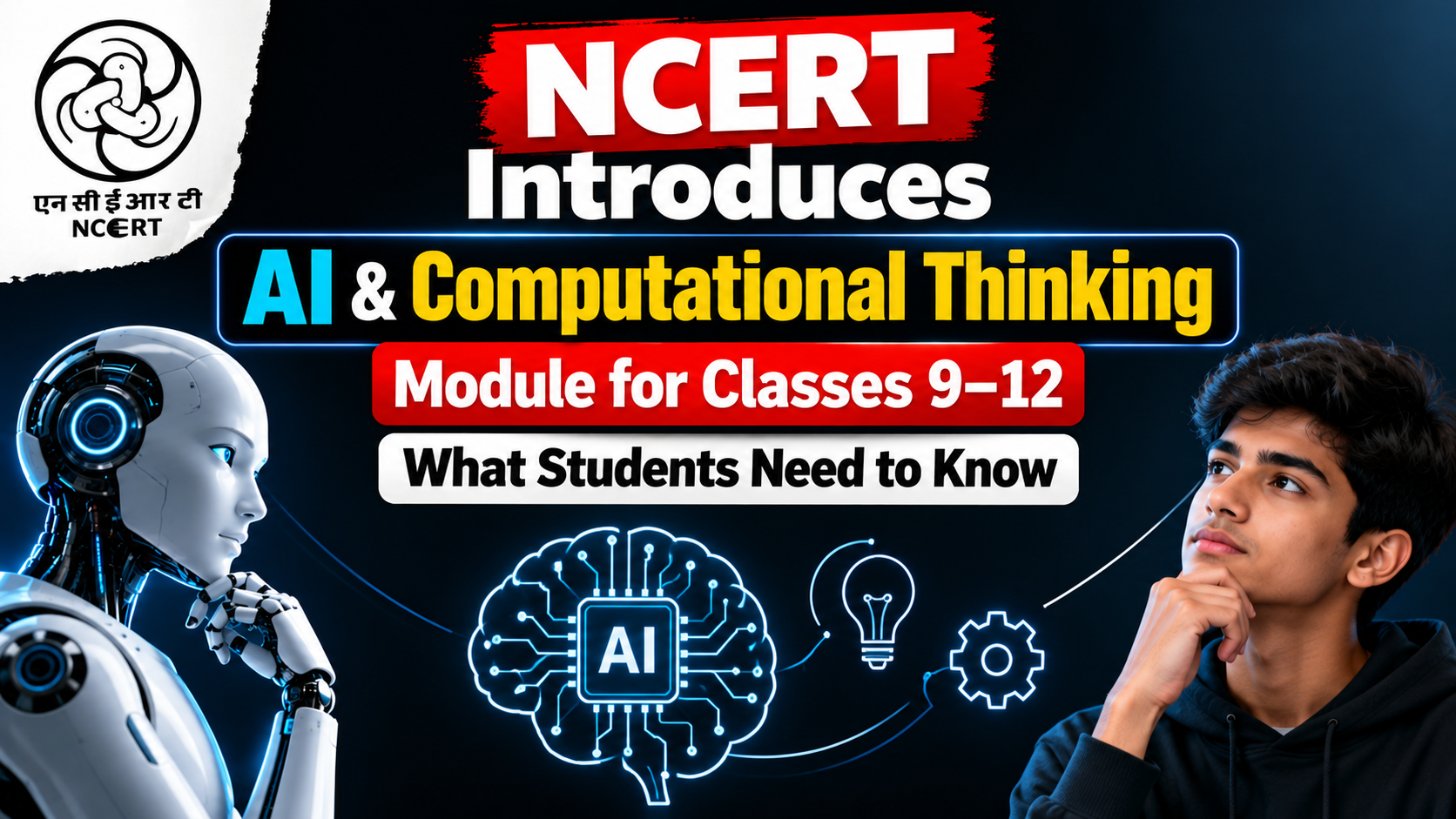
NCERT Introduces Computational Thinking and Artificial Intelligence Module for Classes 9–12: Everything Students Need to Know
Artificial Intelligence (AI) is transforming the way we learn, work, communicate, and solve problems. From AI-powered learning applications to smart assistants and automated technologies, its influence is becoming increasingly visible in our daily lives.
In an important development for school education, the National Council of Educational Research and Training (NCERT) has introduced an introductory module on Computational Thinking (CT) and Artificial Intelligence (AI) for students of Classes 9 to 12. According to the press release dated October 23, 2026, the initiative aims to help students understand these emerging technologies while developing essential skills such as critical thinking, creativity, and problem-solving.
The initiative aligns with the vision of the National Education Policy (NEP) 2020 and aims to make students more confident, informed, and responsible users of technology.
For students, parents, and teachers, this development highlights an important shift in education: learning is not just about remembering information but also about understanding concepts, analysing problems, and applying knowledge in real-life situations.
What Is NCERT's New AI and Computational Thinking Module?
NCERT's introductory module has been developed for the secondary stage, covering Grades 9 to 12. It is designed for students who may have little or no prior knowledge of Artificial Intelligence.
The module introduces students to two important areas:
-
Computational Thinking (CT): A structured way of approaching problems by breaking them into smaller, manageable steps.
-
Artificial Intelligence (AI): Technology that enables computer systems to perform tasks such as recognising patterns, processing information, generating content, and making predictions.
The objective is to help students understand how these technologies work, where they can be used, what their limitations are, and why they must be used responsibly.
Students can explore the official NCERT resource here: NCERT AI and Computational Thinking Module.
What Is Computational Thinking and Why Is It Important?
Computational Thinking is a problem-solving approach that can be applied to mathematics, science, computer science, and everyday situations.
It helps students approach difficult questions logically rather than relying entirely on memorisation.
Computational Thinking generally involves four key concepts:
1. Decomposition
Breaking a complex problem into smaller, simpler parts.
For example, when solving a complicated mathematics question, a student can divide it into smaller steps and solve each step systematically.
2. Pattern Recognition
Identifying similarities, repeated structures, and trends.
For example, recognising a pattern in a sequence of numbers can help students predict the next number or discover a mathematical rule.
3. Abstraction
Focusing on the most important information while ignoring unnecessary details.
For example, when studying a physics problem, students identify the relevant quantities, formulas, and conditions before calculating the answer.
4. Algorithmic Thinking
Developing a clear sequence of steps to solve a problem.
For example, a student can create a step-by-step method to calculate the average marks obtained in five subjects.
These skills can help students improve their logical reasoning, organise their thoughts, and approach unfamiliar questions with greater confidence.
How Will Artificial Intelligence Help Students Learn?
Artificial Intelligence is becoming an important part of education. When used appropriately, AI tools can support learning by explaining concepts, providing practice questions, and helping students explore topics from different perspectives.
Here are some potential educational applications of AI.
1. Understanding Difficult Concepts
Students can use suitable AI tools to explore complicated topics in mathematics, physics, chemistry, biology, and other subjects through simpler explanations and examples.
2. Personalised Learning Support
AI-powered educational platforms may adapt practice activities to a learner's needs, helping students focus on concepts they find challenging.
3. Practice and Revision
Students can use AI tools to generate additional practice questions, revise key concepts, and identify areas where they need further study.
4. Developing Creativity
AI can assist with brainstorming, project planning, visualisation, and exploring different approaches to a problem.
However, students should remember that AI-generated information may contain errors. Textbooks, teachers, official educational resources, and reliable references remain important for verifying information.
Will the New Module Change Education for Classes 9–12?
The introduction of the module reflects a growing emphasis on technology awareness and competency-based learning in school education.
Rather than focusing exclusively on theoretical knowledge, the module encourages an experiential, activity-based approach that includes discussions, practical exercises, experimentation, and reflection.
This approach can help students connect classroom learning with real-world situations.
For example:
-
A Class 9 student can use computational thinking to identify patterns in a mathematical sequence.
-
A Class 10 student can analyse how AI applications recognise images or classify information.
-
A Class 11 student can explore how data is organised and used to identify trends.
-
A Class 12 student can critically evaluate AI-generated information and discuss the ethical implications of using AI in different fields.
These are illustrative learning examples, not a confirmed list of prescribed activities or examination questions from NCERT.
Important clarification: The announcement concerns an introductory module for Grades 9–12. Students should not assume that every AI topic mentioned in this article will automatically become a compulsory board examination subject or that a separate AI examination has been announced. They should check official NCERT, CBSE, and their respective board notifications for details about implementation, assessment, and subject requirements.
Can Students Learn AI Without a Computer?
One notable feature of the announced module is its activity-based approach. According to the press release, activities can be conducted with or without digital devices.
This makes the learning approach potentially accessible to schools with different levels of technological infrastructure.
Students can develop computational thinking through activities such as:
-
Arranging steps in the correct order to solve a problem.
-
Identifying patterns in numbers, shapes, or everyday situations.
-
Creating flowcharts to represent a process.
-
Solving logical puzzles and reasoning challenges.
-
Discussing how AI systems might make predictions from information.
These activities demonstrate that understanding AI begins with learning how to think logically. Access to advanced computers is not the only way to develop these foundational skills.
Why Is Responsible AI Use Important for Students?
As AI tools become more accessible, students must understand not only their benefits but also their limitations and risks.
NCERT's announced module places special emphasis on the ethical and safe use of AI.
Important areas include:
Data privacy: Students should avoid sharing sensitive personal information with AI tools and should understand how digital information may be collected or used.
Misinformation: AI-generated answers, images, and videos can be inaccurate or misleading. Students should verify important claims using trustworthy sources.
Fairness and bias: AI systems may produce unfair results when the information used to develop them contains biases or does not represent different groups adequately.
Digital safety: Students should recognise online risks, protect their accounts, and use digital platforms responsibly.
Critical verification: AI-generated answers should not be accepted automatically as correct. Students must check facts, question assumptions, and compare information with reliable references.
The central message is that technology should support human learning rather than replace independent thinking, creativity, or ethical judgement.
How Should Students of Classes 9–12 Prepare?
Students do not need to become expert programmers overnight to begin understanding Artificial Intelligence. Developing strong fundamentals is a sensible first step.
Here are five practical ways to prepare:
-
Strengthen logical reasoning: Practise mathematical puzzles, sequences, reasoning questions, and problem-solving activities.
-
Understand basic digital concepts: Learn how computers process information, follow instructions, and store data.
-
Explore AI applications: Observe how AI is used in educational apps, search engines, translation tools, and image-recognition systems.
-
Verify information: Compare AI-generated explanations with NCERT textbooks and reliable sources.
-
Use AI as a learning assistant: Ask for explanations and practice exercises, but solve questions independently before checking the answers.
Students preparing for CBSE or State Board examinations should continue to prioritise their prescribed syllabus, textbooks, classroom instruction, and official examination guidelines while building these additional skills.
What Does This Mean for the Future of Education in India?
The growing importance of AI and Computational Thinking reflects a broader change in the skills students may need for higher education and future careers.
Fields such as engineering, data science, healthcare, finance, scientific research, and digital media increasingly involve data, automation, and intelligent technologies.
Early exposure to computational thinking can help students develop transferable skills that are useful across many disciplines.
At the same time, technical knowledge alone is not enough. Creativity, communication, critical judgement, collaboration, and ethical responsibility remain essential.
The focus of modern education should therefore be on helping students understand technology, question information, solve problems, and make informed decisions.
NCERT's initiative is a step towards introducing these ideas to school students in a structured and accessible way.
How Fukey Education Can Help Students Stay Ahead
At Fukey Education, we believe that strong academic fundamentals and conceptual clarity are essential for student success.
For Classes 9 to 12, understanding concepts deeply is important not only for examinations but also for developing the reasoning and analytical abilities that support future learning.
Students can make their learning more effective by combining textbook study with regular practice, concept-based explanations, revision, and independent problem-solving.
As educational developments continue, students and parents should follow official announcements and focus on building skills that remain valuable across subjects.
Explore Fukey Education for educational resources and learning support for school students.
Frequently Asked Questions (FAQs)
1. What has NCERT announced for Classes 9–12?
According to the press release dated October 23, 2026, NCERT has developed an introductory module on Computational Thinking and Artificial Intelligence for students in Grades 9–12.
2. Is prior knowledge of Artificial Intelligence required?
No. The announced module is designed for students with no prior knowledge of AI.
3. What is Computational Thinking?
Computational Thinking is a systematic problem-solving approach that includes breaking problems into smaller parts, recognising patterns, identifying relevant information, and developing step-by-step solutions.
4. Will AI become compulsory in CBSE board examinations?
The announcement described here does not, by itself, establish a new compulsory AI board examination. Students should consult official CBSE and NCERT notifications for confirmed subject and assessment requirements.
5. Can AI and Computational Thinking activities be conducted without computers?
Yes. According to the press release, the module includes activities that can be conducted with or without digital devices.
6. Where can students access the NCERT AI module?
Students can visit the official NCERT AI Textbook and Module page to access the introductory resource.
7. How can students prepare for learning AI?
Students can begin by strengthening logical reasoning, practising problem-solving, learning basic digital concepts, and verifying AI-generated information against reliable sources.
Conclusion
NCERT's introduction of an AI and Computational Thinking module for Grades 9–12 highlights the importance of preparing students for an increasingly technology-driven world.
By encouraging logical reasoning, creativity, practical learning, and responsible technology use, the initiative aims to help students develop skills that extend beyond traditional classroom learning.
For students, the best approach is to stay informed, strengthen academic fundamentals, explore technology thoughtfully, and continue developing independent thinking.
Stay connected with Fukey Education for the latest education news, NCERT updates, CBSE announcements, study resources, and learning guidance for Classes 9–12.


Be the first to comment on this post.