



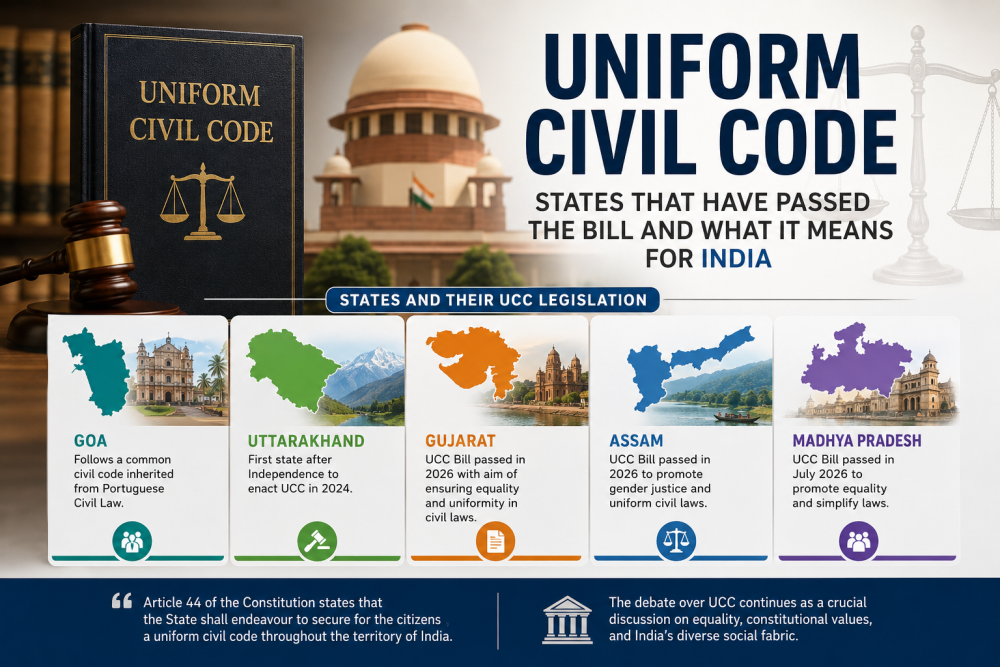
Uniform Civil Code in India 2026: Four States Adopt UCC as Debate Over Article 44 Intensifies
Introduction
The Uniform Civil Code (UCC) refers to a proposal to replace religion-based personal laws with a single, common set of civil laws applicable to all citizens, irrespective of faith. Article 44 of the Constitution lists the UCC as a Directive Principle of State Policy, urging the state to "endeavour to secure" such a code, though it remains non-justiciable. The debate has resurfaced sharply in 2026 as Gujarat, Assam and Madhya Pradesh have followed Uttarakhand in enacting their own state-level UCC legislation, reviving a decades-old constitutional discussion.
What is the Uniform Civil Code?
The UCC seeks to establish uniform laws governing marriage, divorce, inheritance, succession, adoption and maintenance for all citizens, regardless of religion. Currently, these matters are largely governed by separate personal laws — Hindu, Muslim, Christian and Parsi — that differ in provisions relating to marriage age, divorce grounds, polygamy and inheritance shares. Proponents argue a common code would ensure gender justice and equality before law; critics say it risks overriding religious and cultural diversity protected under the Constitution.
States That Have Passed or Implemented the UCC
Goa: Goa is often cited as India's original example of a common civil code, but it is not a newly enacted UCC. The state continues to follow the Portuguese Civil Code of 1867, inherited from colonial rule and retained after Goa's 1961 merger with India. It applies uniformly to all residents regardless of religion, governing marriage, divorce and inheritance.
Uttarakhand: Uttarakhand became the first state in independent India to enact a Uniform Civil Code. The Uniform Civil Code of Uttarakhand Bill, 2024 was passed by the state assembly on 7 February 2024 with unanimous support, and received presidential assent the following month. The law bans polygamy, polyandry, halala and iddat, sets a uniform marriageable age, ensures equal inheritance rights for sons and daughters, and mandates registration of live-in relationships.
Gujarat: Gujarat became the second state to adopt a UCC when its assembly passed the Gujarat Uniform Civil Code Bill, 2026 in March 2026 after a seven-hour debate. The bill, based on recommendations from a committee headed by retired Supreme Court judge Justice Ranjana Prakash Desai, establishes a common legal framework for marriage, divorce, succession and live-in relationships, applicable throughout the state and to Gujarati residents living elsewhere.
Assam: Assam passed the Uniform Civil Code, Assam, 2026 Bill in May 2026, becoming the third state overall and the first in the Northeast to adopt such legislation. Introduced by Parliamentary Affairs Minister Atul Bora on behalf of Chief Minister Himanta Biswa Sarma, the law mandates registration of marriages and divorces within 60 days, requires registration of live-in relationships, and prescribes imprisonment of up to seven years for polygamy. Scheduled Tribe communities are exempted from its provisions.
Madhya Pradesh: Madhya Pradesh became the fourth state to enact a state-level UCC when its Legislative Assembly passed the Madhya Pradesh Uniform Civil Code Bill, 2026 by voice vote on 21 July 2026, amid strong opposition protests. Drafted by a committee also led by Justice Ranjana Prakash Desai, the law bans polygamy, criminalises triple talaq and nikah halala, mandates marriage registration across the state including at village level, and sets the marriageable age at 21 for men and 18 for women. Scheduled Tribe communities are excluded from its scope. The legislation was awaiting presidential assent at the time of passage.
Key Features of the UCC
Across these states, the UCC frameworks share common elements: a uniform legal marriageable age for men and women; standardised, court-monitored divorce procedures; equal inheritance rights for sons and daughters irrespective of religion; regulated adoption processes open to all communities; uniform maintenance provisions for spouses and dependents; compulsory registration of marriages within a stipulated period; and, notably, mandatory registration of live-in relationships, a provision that has drawn particular public attention and criticism on privacy grounds.
Conclusion
As of July 2026, four Indian states — Uttarakhand, Gujarat, Assam and Madhya Pradesh — have passed their own Uniform Civil Code legislation, alongside Goa's pre-existing Portuguese-era common code. Several other states, including Maharashtra, West Bengal and Rajasthan, have constituted expert committees to examine the issue. A nationwide Uniform Civil Code, however, has not yet been enacted or implemented under Article 44. The question continues to generate significant constitutional, legal and political debate around federalism, minority rights and gender equality, ensuring it remains a closely watched issue in India's evolving legal landscape.
Tags :
- Uniform
- Civil
- Code
- UCC
- India
- 2026
- News
- Article
- 44
- Indian
- Constitution
- States
- Uttarakhand
- Gujarat
- Implementation
- One
- Nation
- Law
- Laws
- Personal
- Parliament
- Legal
- Reforms
- Constitutional
- Latest
- Update
- National
- Governance
- Public
- Policy
- Politics
- and
- Justice
- State
- Government
- Social
- Family
- Marriage
- Inheritance
- Equal
- Rights
- Bharat